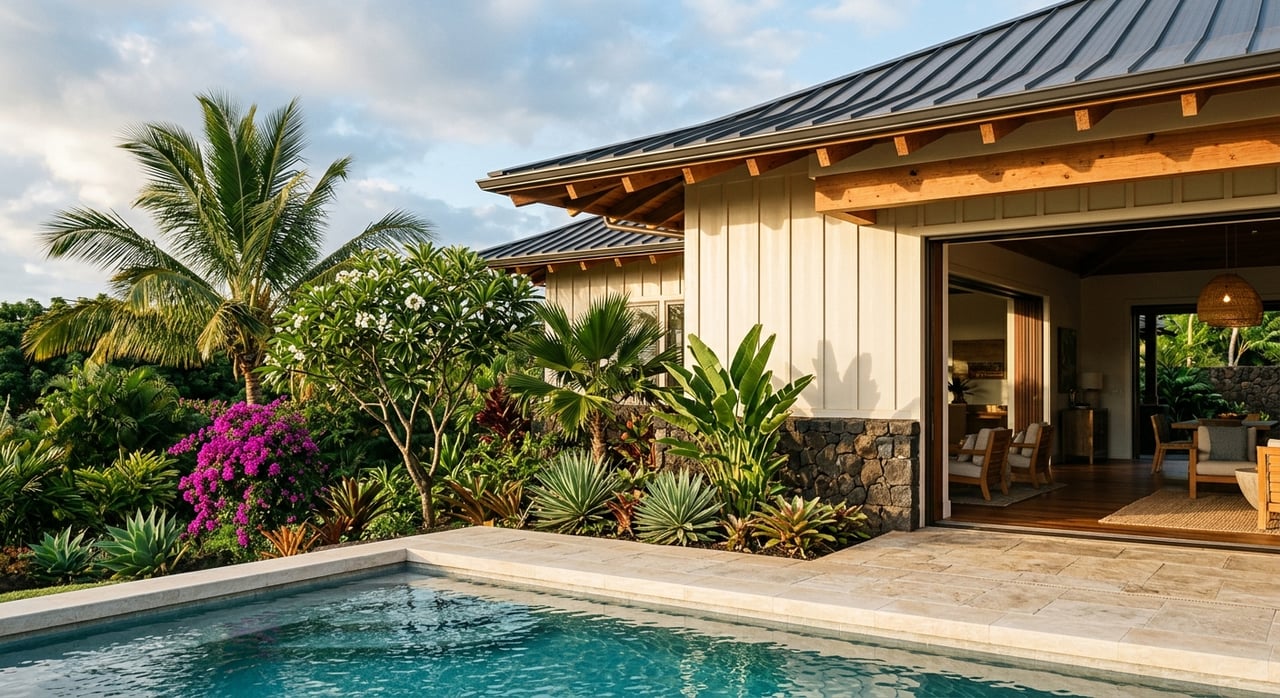
If you are drawn to Launiupoko for its big views, sunny climate, and relaxed West Maui setting, the right home design matters as much as the location itself. A modern plantation home can give you the breezy, indoor-outdoor feel many buyers want, while still fitting the area’s low-density, site-sensitive character. In this guide, you’ll see design ideas that suit Launiupoko’s climate, reflect Maui County guidance, and help you think more clearly about what works on these unique properties. Let’s dive in.
Why modern plantation design fits Launiupoko
Launiupoko sits within the West Maui planning area, where county guidance points to a lower-density setting with a mix of Rural Residential and Agriculture designations. That context supports homes that feel grounded in the land rather than oversized or visually busy. In practical terms, simple forms and thoughtful site planning tend to make more sense here than highly dramatic architecture.
The climate also shapes good design decisions. West Maui is a leeward environment, which means you can expect sunny, dry conditions much of the year, with rainfall often arriving more during winter storm patterns than in an even year-round cycle. That is one reason modern plantation design feels so natural in Launiupoko, since it pairs shade, airflow, and outdoor living in a way that matches local conditions.
Start with simple exterior forms
One of the strongest ideas behind plantation-inspired architecture is restraint. Maui County design guidance describes plantation vernacular as one- or two-story structures with features like lanais, overhanging roof awnings, simple geometric forms, and porches that define the entry or stretch across the front. For a modern version, the goal is not to copy an old house exactly, but to keep the massing calm, balanced, and human in scale.
That often means avoiding a design that tries to do too much at once. Clean rooflines, a clear entry sequence, and a readable overall shape usually feel more appropriate in Launiupoko than a fragmented home with many competing roof peaks and forms. A simpler exterior also tends to age better visually in a landscape where the ocean, sky, and slopes already do most of the dramatic work.
Rooflines that stay true to the style
Roof shape has a big effect on whether a home reads as modern plantation or something else entirely. County guidance supports pitched gable and hip roofs in residential settings, while mansard roofs, A-frames, and octagonal roof forms are considered inappropriate. If you want a home that feels current but still rooted in place, a restrained gable or hip roof is usually the better path.
Wide overhangs are another smart choice. They reinforce the plantation look, help create shade, and support the indoor-outdoor lifestyle many buyers want in West Maui. In a sunny leeward area like Launiupoko, that added shade can make lanais and windows more comfortable throughout the day.
Choose materials that feel classic and durable
Modern plantation homes usually work best when the finish palette stays simple and climate-aware. Maui County guidance points to exterior materials such as horizontal wood lap siding, vertical tongue-and-groove, board-and-batten, and stucco. These materials help a home feel connected to historic architectural language without forcing it into a theme-house look.
If you prefer lower-maintenance products, newer synthetic materials may also be an option when they closely resemble traditional wood and can hold up to local conditions. The key idea is visual authenticity. In Launiupoko, finishes that look warm, matte, and natural usually fit better than highly reflective materials.
Avoid overly reflective finishes
County guidance discourages mirrored glass and polished metals. That matters in a place where sunlight is strong and views are a major part of the experience. A softer material palette tends to sit more comfortably in the landscape and keeps attention on the setting rather than on glare or shine.
You can still create a clean, updated look with modern windows, simple trim profiles, and streamlined detailing. The difference is that the home feels refined rather than flashy. That balance is often what gives a modern plantation home staying power.
Make lanais the heart of the home
In Launiupoko, a lanai should not feel like an afterthought. With mild temperatures, trade winds, and the sunny, dry conditions common to leeward West Maui, outdoor living spaces can become part of your daily routine for much of the year. That makes the lanai one of the most valuable design features in the entire home.
A successful layout often treats the lanai as a true outdoor room. Covered dining areas, lounge seating, and shaded transition zones can help connect the interior to the site in a way that feels easy and natural. Instead of separating indoors and outdoors too sharply, the best homes create a smooth flow between them.
Use breezeways and shaded transitions
Shaded connectors can improve both comfort and style. Breezeways, covered walkways, and deep porch edges support airflow while softening the movement from inside to outside. They also reinforce the plantation tradition of practical design shaped by climate.
This approach can be especially useful on larger lots, where the home may stretch across the site rather than stack vertically. A sequence of connected spaces often feels more livable and site-sensitive than one large block of enclosed square footage.
Design the site around views, slopes, and drainage
In Launiupoko, the lot itself should guide many design decisions. Maui County recommends considering views to preserve or screen, slopes, existing plants, rocks, and drainage before finalizing a xeriscape or broader site plan. That advice is especially important on view-oriented hillside properties where grading, runoff, and outdoor placement all affect the finished result.
A beautiful home in this area is usually one that feels tuned to the land. That may mean orienting outdoor areas to protect key view corridors, using planting to soften certain edges, or shaping hardscape in a way that works with drainage instead of against it. Good design here is rarely just about the house alone.
Treat pools and decks as part of the whole plan
A pool court can be a major feature, but it should still feel integrated into the site. County guidance emphasizes drainage, runoff capture, slopes, and views, which suggests that pools and decks should be planned as part of the overall landscape system. In other words, the pool area should support the property’s function and setting, not compete with it.
This is where thoughtful placement matters most. A well-positioned pool can frame an outdoor room and preserve a clean visual connection to the horizon. A poorly placed one can interrupt circulation, create drainage headaches, or dominate the lot in a way that feels out of step with Launiupoko’s more restrained character.
Use water-wise landscaping that matches the microclimate
Lush landscaping may look appealing in photos, but it is not always the best fit for Launiupoko’s sunny and dry conditions. Maui County recommends organizing landscape zones by moisture, sun, shade, air movement, and heat. The county also advises using very low-, low-, and moderate-water zones, with moderate-water areas kept smaller and closer to high-use spaces such as entries.
That kind of planning can make a property look better and function better. It helps you use water more carefully while creating a landscape that responds to how different parts of the lot actually perform. On a larger property, that can also make maintenance more manageable over time.
Choose coastal-appropriate plants
County planting guidance notes that lowland and coastal species such as wiliwili and kou are suited to hot coastal areas with strong ocean breezes. By contrast, mountain species such as koa and maile are not a good fit for those conditions. For Launiupoko, that means a drought-tolerant, coastal-appropriate palette is usually the smarter choice.
Visually, this can create a cleaner and more natural result than trying to force a high-water tropical look onto a dry, breezy site. Grouping plants by water need and microclimate also supports healthier growth and more efficient irrigation. The end result can feel polished without looking overdesigned.
Keep guest ohana designs subordinate
Many buyers in Maui use the term ohana for a guest unit, but Maui County refers to these as accessory dwellings. The county says accessory dwellings are only allowed in zoning districts that specifically permit them, and that size depends on the lot’s net area. They may be stacked, attached to the main dwelling, or detached.
In design terms, the best accessory dwellings in Launiupoko usually stay visually secondary to the main house. County guidance for accessory structures supports simple forms, basic roof types such as hip, gable, or shed, and understated materials like vertical siding or board-and-batten. That tends to support compact guest cottages or attached suites that echo the main home rather than competing with it.
Understand ag-lot permit paths early
On agricultural lots, the permit path is a major part of the design conversation. Maui County says a Farm Dwelling and Agriculture Structures Declaration is required for a farm dwelling, accessory agricultural structure, or private garage permit. The county also notes that projects in the Special Management Area require SMA clearance, and shoreline-area projects require shoreline setback review.
That is why early planning matters. If you are considering a guest unit, garage structure, or other secondary building, it helps to think about compliance at the same time you think about style. In Launiupoko, the most successful homes are usually the ones where aesthetics and permitting have been considered together from the start.
Focus on a home that feels grounded
The best modern plantation homes in Launiupoko do not try to overpower the site. Instead, they combine simple rooflines, shaded lanais, human-scale proportions, climate-appropriate materials, water-wise landscaping, and carefully planned accessory structures. That mix creates a home that feels relaxed, durable, and connected to West Maui.
If you are evaluating homes in Launiupoko, these design ideas can help you spot what is likely to age well, function well, and feel right for the setting. And if you are preparing to buy or sell a property with these features, understanding the design logic behind them can help you make stronger decisions. For guidance on Launiupoko and the broader West Maui market, connect with Mark Marchello.
FAQs
What defines a modern plantation home in Launiupoko?
- A modern plantation home in Launiupoko usually blends simple forms, gable or hip roofs, generous overhangs, lanais, human-scale proportions, and exterior materials such as lap siding, tongue-and-groove, board-and-batten, or stucco.
Why are lanais important for Launiupoko homes?
- Lanais suit Launiupoko because West Maui’s leeward climate is often sunny and dry, which supports shaded outdoor living areas that can be used much of the year.
What landscaping works best for Launiupoko properties?
- Water-wise landscaping that is organized by microclimate, sun, shade, air movement, and water needs is generally the best fit, especially with coastal-appropriate plant choices for hot and breezy conditions.
Can you build an ohana in Launiupoko?
- An accessory dwelling may be possible only where the zoning district specifically allows it, and the permitted size depends on the lot’s net area, so the specific property details matter.
What should you consider before adding a pool in Launiupoko?
- A pool should be planned with the site’s slopes, drainage, runoff capture, and view corridors in mind so it functions as part of the overall property design.