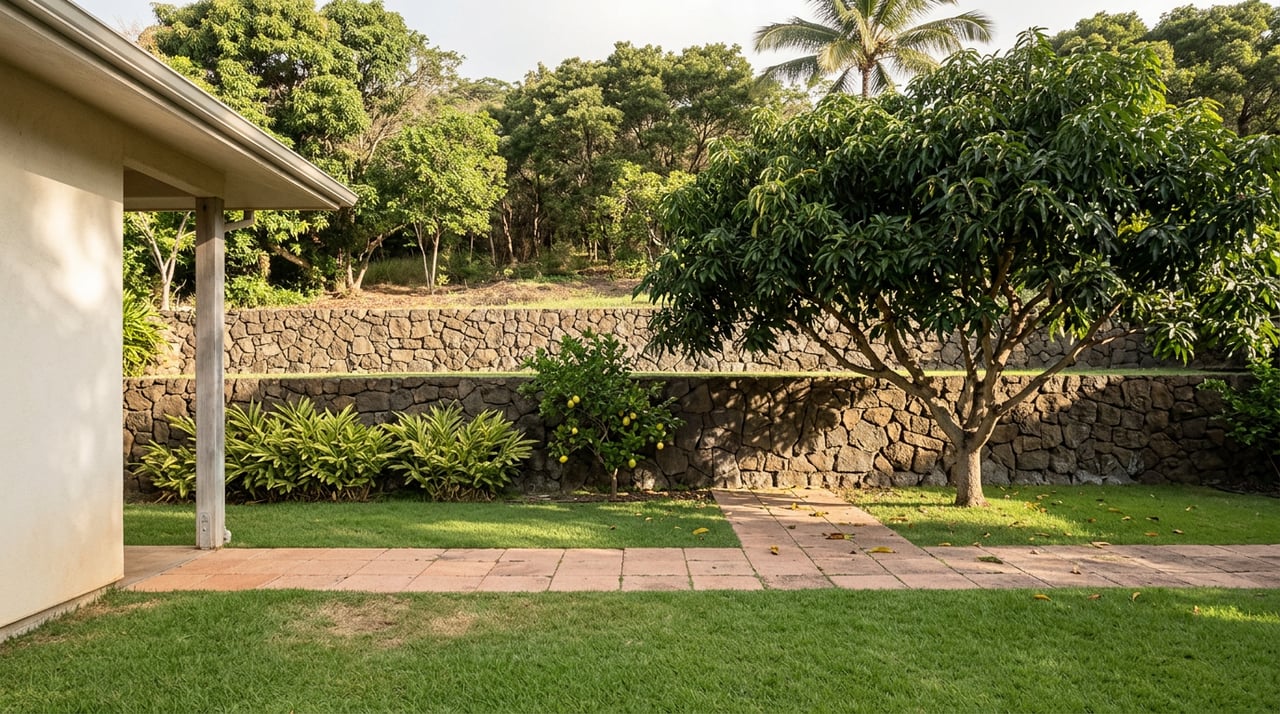
In 2022, the owner of a small chocolate farm in Launiupoko wrote to Hawaii's water regulators pleading for irrigation water to be restored. The farm had done everything the county asked: planted orchards, filed a farm plan, complied with the agricultural zoning that makes Launiupoko what it is. The letter said the plants were dying of thirst and asked regulators to approve a pending rate increase just to get ag water flowing again.
That is the backdrop against which Maui County is now moving to buy Launiupoko's water system outright. If you are comparing this hillside against Kaanapali or Napili right now, the ag zoning and the CPR paperwork are the parts every guide walks you through. The water system has been privately owned, and the county is considering acquiring it; the county's projections suggest the transition could result in higher rather than lower rates.
A System That Was Never Public to Begin With
Launiupoko runs on two separate water companies, not one. Launiupoko Water Co. LLC delivers potable drinking water, formed in 2002 by three land entities and certified by the state Public Utilities Commission in June 2003. Launiupoko Irrigation Co. LLC handles the non-potable side, built on infrastructure that Pioneer Mill used to grow sugar cane on this same land for a century and a half, certified separately in October 2003. Day-to-day billing and monitoring for both systems runs through West Maui Land Company, not the county.
That dual setup is why Launiupoko lots can support orchards, pasture, and a working farm plan in a way most West Maui neighborhoods can't. It's also why the water has always depended on the health of two small private operators, not on the same public infrastructure backing a home in Kahului or Wailuku.
The strain on that private system is documented, not theoretical. Launiupoko Irrigation Co. needs to deliver roughly 2 million gallons a day to its customers. When stream flow restrictions on the Kaua'ula watershed tightened, the available supply stopped covering demand, and the company began blending potable water into the non-potable line just to keep up. Around the same time, Hawaii's Water Commission designated the entire Lahaina Aquifer Sector, Launiupoko included, as a surface and groundwater management area, citing concerns about the system's long-term ability to keep pumping through drought. The Public Utilities Commission responded by approving a tiered rate structure that replaced a flat 76 cents per thousand gallons with rates starting at $1.50 per thousand gallons for the first tier alone.
That history is why the same 2022 round of testimony includes a blunter line from another Launiupoko owner entirely.
"Our Ag water has been permanently turned off."
That's not a hypothetical buyer's worry. It is what a Launiupoko property owner told state regulators in writing during the shortage.
What the County's Projections Say About Future Rates
On July 27, 2026, the Maui County Council's Water and Infrastructure Committee took up Resolution 26-116, a proposal for the county's Department of Water Supply to acquire both the Launiupoko and Olowalu private water systems for a combined $6 million. Maui Now reported on the discussion three days later. The deal would move wells, distribution pipelines, booster pumps, reservoirs, and easements into county hands, part of a stated push by Mayor Richard Bissen to raise public ownership of West Maui's drinking water systems from 45 percent to 93 percent.
The numbers presented to the committee are where this gets interesting for anyone doing due diligence on a Launiupoko purchase right now.
| Launiupoko System | Olowalu System | |
|---|---|---|
| Active connections | 402 | 79 potable + 72 non-potable |
| 2025 water produced | ~276 million gallons | not disclosed |
| Appraised value | $8,056,000 | $1,978,000 |
| County purchase price | $3,500,000 | $2,500,000 (a premium over appraisal) |
| County's projected annual revenue | ~$2,560,000 | $734,363 |
| County's estimated annual operating cost | $879,664 | $671,554 |
The Launiupoko figures show projected annual revenue exceeding operating costs by roughly $1.68 million. Council Member Tamara Paltin pointed out during the hearing that both private companies have been operating at a loss under current rates set by the state PUC, while the county's projections show a comfortable surplus, a gap she attributed largely to the county's higher rates in the upper usage tiers.
Council Member Keani Rawlins-Fernandez asked whether those revenue projections accounted for customers cutting back usage once rates climbed. The Department of Water Supply's deputy director acknowledged they did not.
None of this means Launiupoko's water is becoming unaffordable. It means the figures presented to the council point toward higher rather than lower rates, but do not establish whether public ownership will mean more predictable utility bills.
The Gap Between a Signed Contract and a Closed Sale
The purchase still needs both Maui County Council approval and Public Utilities Commission sign-off, and the county is not expecting the sale to close until April 2027. That's roughly eight months from today.
If you write an offer on a Launiupoko property this fall, you could close escrow under the current private ownership structure and still be living there when the county takes over the following spring, under a rate schedule that hadn't been finalized when you signed. That's not a reason to avoid the neighborhood. It's a reason to ask sharper questions before you do.
A short list worth bringing to your own due diligence, beyond the standard ag-zoning and CPR review:
- Request the seller's actual water bills for the past 12 to 24 months from both Launiupoko Water Co. and Launiupoko Irrigation Co., not just an estimate.
- Ask whether the parcel's non-potable meter is active and current on backflow preventer requirements, since that's billed separately from the meter itself and is easy to miss in a quick walkthrough.
- Confirm the parcel's farm plan is tied to a working non-potable allocation, not a paper allocation that assumed water availability the private system has struggled to guarantee in dry years.
- Ask your agent or title company to flag whether the county's acquisition has closed by the time you're under contract, since that changes who you're calling if service issues come up after move-in.
Part of a Larger Pattern, Not a One-Off Deal
Launiupoko isn't an isolated case. The county paired this purchase with a similar deal for Olowalu's water system in the same resolution, and in May 2026 Bissen had already announced a separate agreement with Maui Land & Pineapple Co. to acquire the Honokōhau Ditch System and lease the Puʻu Kukui Watershed, a larger system whose price was still being negotiated at the time. Bissen has tied the broader effort to freeing up water capacity for affordable housing, agriculture, emergency preparedness, and Native Hawaiian cultural practices across West Maui.
That context matters for a Launiupoko buyer because the rate structure the county sets here won't exist in a vacuum. It's likely to become a template as more of West Maui's private water infrastructure moves under public control over the next several years.
Will my water bill definitely go up if I buy in Launiupoko now?
Not definitely, but the county's own projections for this specific system assume higher revenue than the private operator has historically collected. Ask for the seller's actual bills rather than relying on a general estimate.
Does this affect the ag water used for farm plan compliance?
It could. The non-potable system feeding farm plans is the Launiupoko Irrigation Co. side of this same sale, and it's the side with the more documented history of shortages during drought years.
Is the sale a done deal?
No. It still needs full Maui County Council approval and Public Utilities Commission sign-off, and the county isn't projecting a closing date before April 2027.
Launiupoko's mix of acreage, ocean views, and working farm character is real, and none of this changes why buyers seek it out. What it changes is which questions get asked before an offer goes in. If you're weighing a Launiupoko property against another West Maui hillside and want someone who tracks the infrastructure story behind the listing, not just the listing itself, The Marchello Team has been doing exactly that kind of homework in Lahaina for years. Reach out and start your West Maui home search with the full picture in hand.
This article is general information, not legal, tax or financial advice. Consult a qualified professional about your situation.