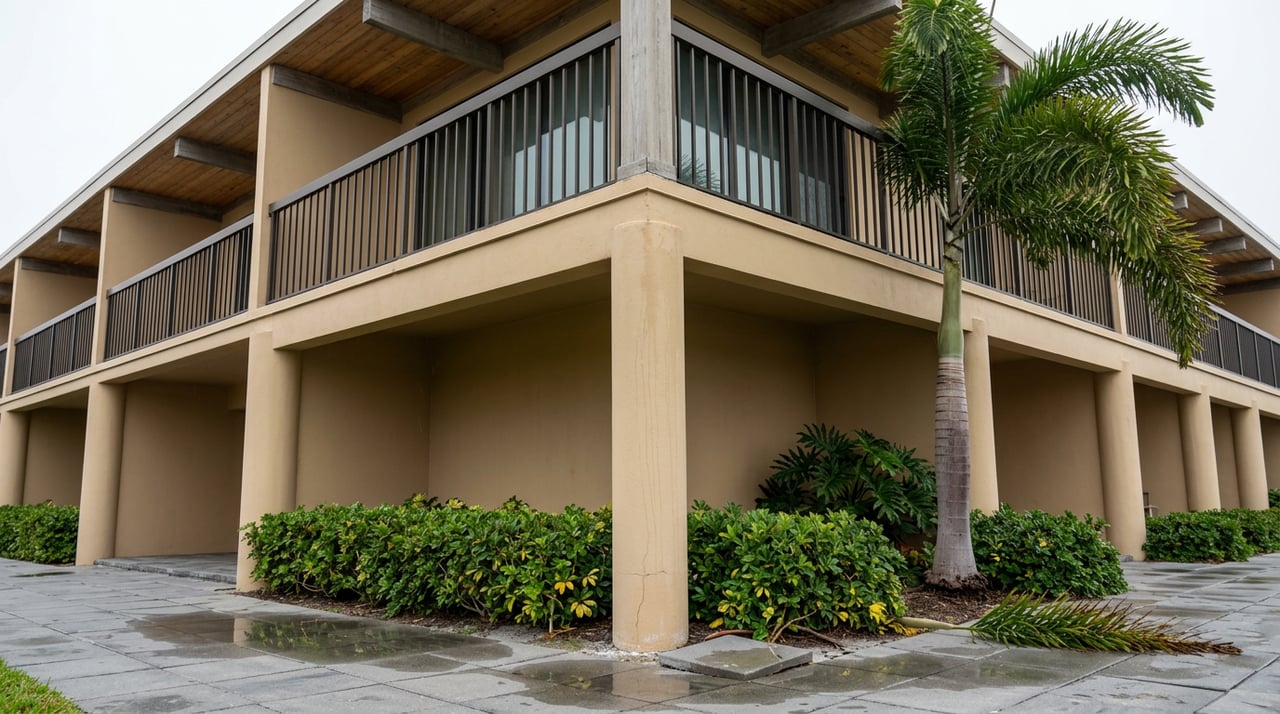
At a Maui County Council hearing this August, an owner named Gerald Kelly made an argument that would have sounded backwards five years ago. He wanted the county to recognize that his building, a 28-unit oceanfront complex called Nohonani on Lower Honoapiʻilani Road in Honokōwai, sits close enough to a rising Pacific that its shoreline exposure should count in the building's favor. In written testimony to the Housing and Land Use Committee, he noted, as Maui Now reported, that "official state GIS data shows the Nohonani is at least as vulnerable as included properties." He wasn't asking for disaster relief. He was asking to keep his condo's vacation rental license.
That sentence only makes sense once you understand what Maui County built into Bill 9, and it changes how you should read a listing anywhere along the Kahana and Honokōwai shoreline.
The rule that turned a liability into a leverage point
Mayor Richard Bissen signed Ordinance 5909, better known as Bill 9, into law on December 15, 2025. It phases out short-term vacation rentals in apartment-zoned buildings across the county, the roughly 7,000 units known as the Minatoya List. West Maui's deadline lands January 1, 2029. The rest of the county follows in 2031.
Six months later, the council passed a fix. Ordinance 6008, or Bill 88, took effect June 22, 2026, and created two new zoning categories, H-3 and H-4, that let a qualifying apartment-zoned building convert to hotel zoning and keep renting nightly forever. Getting on that list isn't automatic. The council has to pass a resolution naming your building, one property at a time, and it's doing that in waves.
The wave that matters most for Kahana is built around a single idea: if a building sits inside the county's Sea Level Rise Exposure Area, mapped using a 3.2-foot coastal erosion threshold projected out to 2100, it's treated as a poor candidate for converting to long-term affordable housing anyway. If the shoreline is expected to take the building eventually, the county's reasoning goes, there's little housing stock lost by letting it keep operating as a rental until then. Erosion exposure, in other words, has become one of the arguments a building's owners can make to stay in the nightly rental business.
Four Kahana buildings, four different regulatory doors
The same stretch of shoreline has produced very different outcomes, because the doors buildings are using aren't the same door.
| Building | What's happening on the shoreline | Which door it's using |
|---|---|---|
| Hololani | Sandbags since the 2006-07 winter, later a rock revetment with public access stairs; Citizen Portal reported that state testimony described it as grandfathered under a 2020 state law | Independent shoreline permitting, not tied to the Bill 9 rezoning waves |
| Kahana Reef | Long-running special assessment, reported at $600 or more a month, funding seawall permitting | Proposed for the sea-level-rise track (Resolution 26-129) in an August 2026 council amendment |
| Kahana Outrigger | Leasehold structure across its parcels | Already advanced through Resolution 26-110, on leasehold and timeshare grounds, not erosion |
| Kahana Sunset | Two buildings sitting at the waterline; one has had 12 units empty since March 2021 | Absent from either rezoning wave in the record reviewed here, and, per the most recent public reporting available, still without a finished managed retreat plan |
Papakea, just south toward Honokōwai, has already been folded into Resolution 26-111 on different grounds entirely. The county's rationale there isn't erosion. It's that the building already operates like a hotel.
Four buildings, four regulatory situations, one ocean. The difference isn't how close each sits to the water. It's that they are proceeding through different regulatory pathways.
Questions raised by the mapping
As Maui Now reported, resident Johann Lall told the council he'd taken the eight properties originally listed in Resolution 26-129 and checked each one against the county's own sea-level-rise mapping. Only four, he found, sit entirely inside the exposure zone. The other four are only partially inside it. He also found 11 parcels sitting entirely inside the zone, and 44 more partially inside it, that appear on neither rezoning resolution at all.
That's the backdrop against which Kahana Reef and Nohonani were proposed for addition. Council Chair Alice Lee's amendment, noticed for the August 5 meeting, proposed adding nine properties to Resolution 26-129, citing sea-level-rise exposure as the single justification for all of them. Nohonani wasn't originally on the list. A group of owners, including Maria O'Donnell, who has held her unit since 1973, argued in writing that the building sits on the same tax plat as three properties already included and that its omission looked like a clerical error rather than a deliberate finding. The committee met on the resolutions twice, on August 5 and again on August 19, and recessed both times with testimony still unfinished and no vote taken on either measure.
The takeaway for a buyer isn't which specific units land on the final list. It's that the list is still moving, and buildings are being considered through individual resolutions and testimony rather than solely by a fixed line on a map.
What the same erosion has already done to prices
None of this is theoretical for the market. As of mid-2026, apartment-zoned Minatoya List condos, the category Bill 9 directly targets, were selling close to 50 percent below their 2022-2023 highs. Hotel- and business-zoned buildings in the same neighborhoods held their value through the same period, some with little to no decline at all.
That gap is the whole reason a rezoning resolution is worth fighting over. For a Kahana or Honokōwai condo, the difference between A-2 apartment zoning and H-4 hotel zoning isn't a line in a county planning document. It's the difference between a building that can rent nightly indefinitely and one that has to convert to long-term housing, or sit dark, after January 1, 2029.
Before you write an offer on Lower Honoapiʻilani Road
- Ask for the building's Tax Map Key and check it directly against the current text of Resolutions 26-110, 26-111, 26-129, and 26-130 on the county's own resolutions page. The lists are still being amended, so a summary from last month may already be out of date.
- Ask whether the building belongs to the Kahana Bay Steering Committee, the nine-complex group sharing engineering and permitting costs for shoreline armor, or has been managing erosion on its own. That distinction shows up directly in the maintenance fee history.
- Pull the association's last two years of board minutes and look specifically for language about special assessments tied to seawall, revetment, or sandbag permitting.
- Ask your lender or escrow officer whether the building's zoning status is affected by the two lawsuits currently challenging Bill 9's constitutionality, Malter v. Maui County and Lynam v. County of Maui, both still pending in Second Circuit Court.
- If nightly rental income is part of the plan, confirm in writing whether the building's current zoning is A-1, A-2, or already reclassified to H-3 or H-4. That single fact determines whether 2029 is a deadline you need to plan around or a date that doesn't touch you at all.
A few questions we hear often
Does owning in Kahana automatically mean I'm caught up in the phase-out? Only if the building is zoned Apartment (A-1 or A-2) and isn't included in an adopted H-3/H-4 rezoning resolution. Hotel- and business-zoned buildings were never part of Bill 9's scope.
When does the West Maui deadline actually take effect? January 1, 2029, for apartment-zoned buildings in West Maui, including Kahana and Honokōwai, unless the building has secured hotel rezoning before then.
Is the sea-level-rise rezoning wave settled? Not as of this writing. Resolutions 26-129 and 26-130 had gone through two recessed committee sessions, August 5 and August 19, with testimony still unfinished and no council vote taken. Anyone evaluating a specific building should check the county's current resolution text rather than relying on a snapshot from any single month.
The address on the listing is only half the story
None of this means Kahana or Honokōwai should be crossed off a list. It means the building matters more than the beach it sits on. Two condos a hundred yards apart can be heading toward opposite rental futures depending on paperwork most buyers never think to ask for.
This is exactly the kind of detail Mark, Andy, and Kristen track for clients looking at West Maui oceanfront, because a great lanai view and a defensible rental license aren't always the same thing. If you're comparing units along this stretch of coast, The Marchello Team can walk you through what a specific building's zoning status, assessment history, and resolution standing actually mean for your plans. Start Your West Maui Home Search when you're ready to look closer.
This article is general information, not legal, tax or financial advice. Consult a qualified professional about your situation.